Semaglutide vs tirzepatide: what the head-to-head trial found
The one direct head-to-head trial found that tirzepatide led to greater average weight loss than semaglutide.
In SURMOUNT-5, researchers randomized 751 adults with obesity to a maximum tolerated dose of tirzepatide (10 or 15 mg) or semaglutide (1.7 or 2.4 mg), once weekly, for 72 weeks. Average weight loss was 20.2% with tirzepatide and 13.7% with semaglutide.
That is the strongest comparative evidence available. But it answers one question, in one population, over 72 weeks. It does not settle which drug is "better" in any general sense, and large parts of the evidence for the two drugs cannot be compared at all.
The head-to-head trial: SURMOUNT-5
SURMOUNT-5 is the trial that makes this comparison possible. Before it, every semaglutide-versus-tirzepatide comparison was indirect: two drugs tested in two separate programs, in different people, at different times.
The trial enrolled adults with obesity (body mass index of 30 or higher) or overweight (27 or higher) with a weight-related health condition, who did not have diabetes. It was open-label, meaning participants knew which drug they received. Each participant was titrated to a maximum tolerated dose of tirzepatide (10 or 15 mg) or semaglutide (1.7 or 2.4 mg), once weekly, added to a reduced-calorie diet and increased physical activity, for 72 weeks.
The primary outcome was percent change in body weight at week 72. Tirzepatide reduced body weight by an average of 20.2% (95% confidence interval 19.1 to 21.4), compared with 13.7% (95% confidence interval 12.6 to 14.9) for semaglutide. The difference was statistically significant (P<0.001).
Larger weight reductions were also more common with tirzepatide. 81.6% of tirzepatide participants lost at least 10% of body weight, compared with 60.5% on semaglutide. For at least 20% weight loss, the figures were 48.4% versus 27.3%.
Waist circumference, a secondary outcome, fell by an average of 18.4 cm (95% confidence interval 17.2 to 19.6) with tirzepatide and 13.0 cm (95% confidence interval 11.7 to 14.3) with semaglutide.
These are averages from one randomized trial. They describe what happened in this group over 72 weeks. They are not a prediction for any individual, and they say nothing about outcomes the trial did not measure.
What about type 2 diabetes? SURPASS-2
SURMOUNT-5 studied people without diabetes. A separate head-to-head trial, SURPASS-2, compared the two drugs in adults with type 2 diabetes.
In SURPASS-2, participants with type 2 diabetes already taking metformin were randomized to tirzepatide 5 mg, 10 mg, or 15 mg once weekly or to semaglutide 1 mg once weekly for 40 weeks. Like SURMOUNT-5, the trial was open-label. The primary outcome was change in blood sugar (HbA1c).
HbA1c fell by 2.01 percentage points with tirzepatide 5 mg, 2.24 with 10 mg, and 2.30 with 15 mg, compared with 1.86 with semaglutide 1 mg.
Body weight fell by 7.6 kg, 9.3 kg, and 11.2 kg across the tirzepatide doses, versus 5.7 kg with semaglutide.
Note the doses. SURPASS-2 used semaglutide 1 mg, the diabetes dose, not the 2.4 mg weight-management dose from SURMOUNT-5. The two head-to-head trials therefore answer different questions in different populations, and their results should not be mixed into a single ranking.
Why the separate trial programs cannot be compared directly
Most of what is written about semaglutide versus tirzepatide compares numbers across the two development programs: the STEP trials for semaglutide and the SURMOUNT trials for tirzepatide. That comparison is weaker than it looks.
In STEP 1, semaglutide 2.4 mg reduced body weight by an average of 14.9% versus 2.4% for placebo at 68 weeks. In SURMOUNT-1, tirzepatide 15 mg reduced body weight by an average of 20.9% versus 3.1% for placebo at 72 weeks.
It is tempting to line those figures up side by side. The trial record does not support doing so. The programs enrolled different participants, ran at different times, used different designs, and measured outcomes over different durations. A larger number in one program does not prove a larger effect in a shared population.
Our semaglutide research profile states this directly: different molecule, different evidence base, and indirect comparisons across trials cannot substitute for head-to-head evidence. SURMOUNT-5 is valuable precisely because it is the exception.
The interactive comparison tool applies the same discipline: it compares only matched, measured outcomes and leaves everything else visible as "Not studied."
What the evidence does not compare
Weight loss is where the head-to-head evidence exists. Elsewhere, it does not.
Cardiovascular outcomes. Semaglutide has SELECT, a cardiovascular-outcomes trial in 17,604 adults with overweight or obesity and established cardiovascular disease but without diabetes. Major adverse cardiovascular events occurred in 6.5% of the semaglutide group versus 8.0% of the placebo group (hazard ratio 0.80). No comparable published cardiovascular-outcomes trial of tirzepatide in obesity without diabetes was in our reviewed sources. A large cardiovascular-outcomes trial of tirzepatide (SURMOUNT-MMO) is ongoing, with results expected in coming years. The heart-outcome evidence for the two drugs is therefore not comparable today.
Authorization by country. In the United States, semaglutide is FDA-approved as Wegovy for chronic weight management and as Ozempic for type 2 diabetes; tirzepatide is FDA-approved as Zepbound for chronic weight management and as Mounjaro for type 2 diabetes. In Canada, Wegovy, Ozempic, and Mounjaro are approved; Health Canada authorized Zepbound for chronic weight management in May 2025 and added obstructive sleep apnea in adults with obesity in June 2026.
Long-term safety. Both US labels carry a boxed warning for thyroid C-cell tumors observed in lifetime rodent studies, with unknown relevance to humans. Beyond the trial durations studied, the comparative long-term safety record is still being written. Our thyroid warning explainer covers what the semaglutide warning is based on and what the human data does and does not show.
Populations not studied head to head. SURMOUNT-5 excluded people with diabetes. SURPASS-2 studied only people with diabetes, at different doses. Neither trial establishes how the comparison looks in adolescents, in older adults with frailty, or over treatment spans longer than 72 weeks.
Side effects in the trials
In SURMOUNT-5, the most commonly reported adverse events in both treatment groups were gastrointestinal: nausea, vomiting, diarrhea, and constipation. This matches the pattern seen across the STEP and SURMOUNT programs.
Discontinuation because of adverse events occurred in 6.1% of tirzepatide participants and 8.0% of semaglutide participants.
These figures describe what participants reported in a controlled trial setting. They are not a complete safety profile, and they do not capture rare events that trials of this size are not powered to detect.
The evidence grade, and why
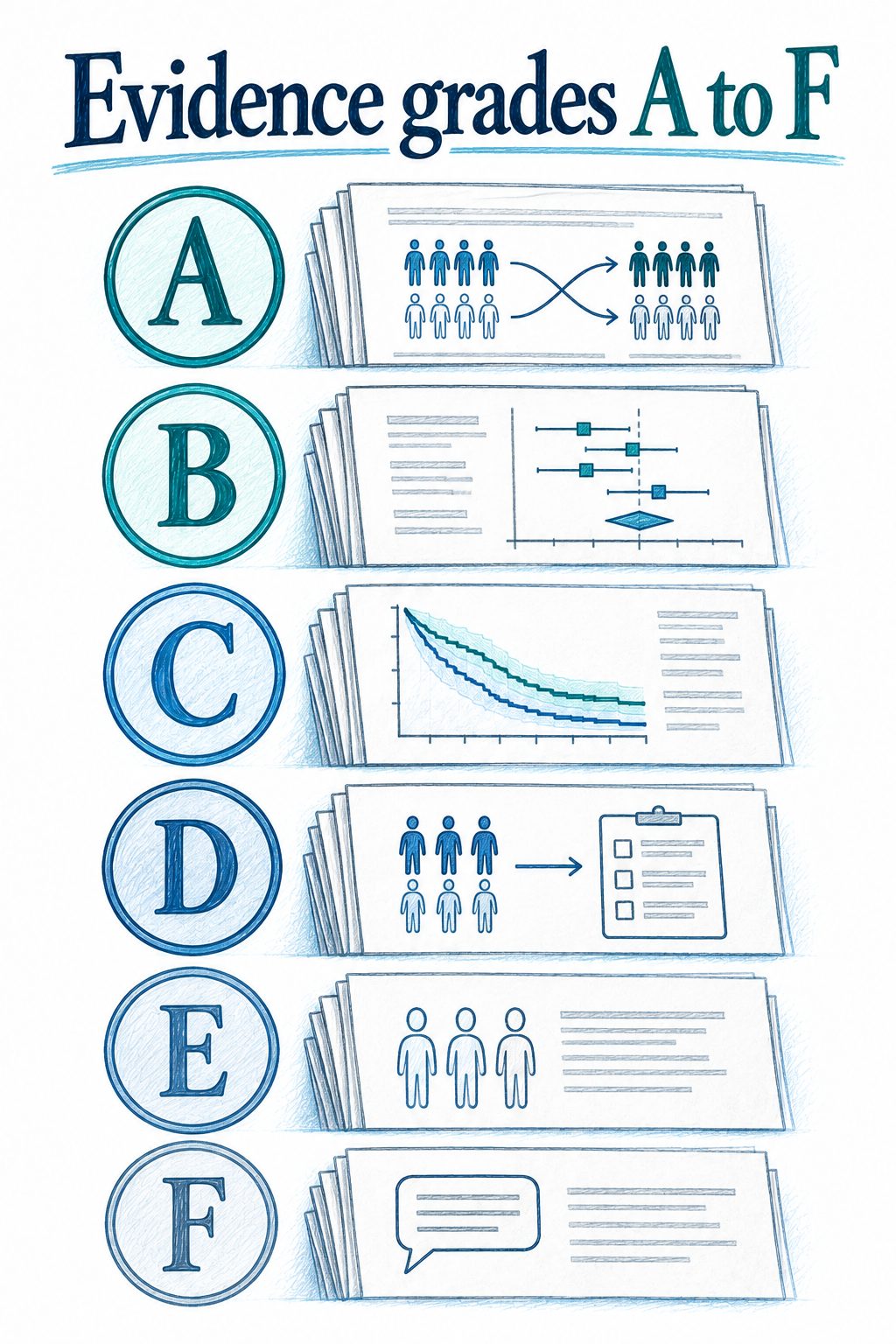
Applying our evidence approach to each comparison separately, rather than to either drug as a whole:
Weight reduction versus placebo: high certainty for both drugs. Multiple large randomized trials (STEP 1, STEP 5, SURMOUNT-1) show consistent, precisely estimated weight loss against placebo in adults with overweight or obesity.
Tirzepatide versus semaglutide for weight loss: moderate certainty for the direction (tirzepatide greater), based on a single large randomized trial. One trial means consistency across studies cannot yet be assessed, and the estimate could shift as more head-to-head evidence accumulates.
Cardiovascular outcomes, compared: insufficient evidence for a comparison. The semaglutide evidence exists; the tirzepatide comparator does not. We found no published cardiovascular-outcomes trial of tirzepatide in obesity without diabetes in the sources reviewed. That means we do not know how the two compare on heart outcomes. It does not mean there is no difference.
See how we rank peptides by evidence strength for where each compound sits on the overall ladder, and the weight management research topic for the full trial record behind these grades.
Bottom line
The direct evidence says tirzepatide led to greater average weight loss than semaglutide in one 72-week trial in adults with obesity who did not have diabetes: 20.2% versus 13.7%.
In type 2 diabetes, SURPASS-2 found larger HbA1c and weight reductions with tirzepatide than with semaglutide 1 mg over 40 weeks.
Everything else about the comparison is thinner than the weight-loss headlines suggest. The separate trial programs cannot be lined up directly, the cardiovascular evidence exists for only one of the two drugs, and long-term comparative safety is still unknown.
That is the honest shape of the evidence: one clear head-to-head answer on weight, and open questions everywhere else.
Sources
Aronne LJ, et al. Tirzepatide as Compared with Semaglutide for the Treatment of Obesity. N Engl J Med. 2025;393(1):26-36. PMID: 40353578. DOI: 10.1056/NEJMoa2416394.
Frías JP, et al. Tirzepatide versus Semaglutide Once Weekly in Patients with Type 2 Diabetes. N Engl J Med. 2021;385(6):503-515. PMID: 34170647. DOI: 10.1056/NEJMoa2107519.
Jastreboff AM, et al. Tirzepatide Once Weekly for the Treatment of Obesity. N Engl J Med. 2022;387(3):205-216. PMID: 35658024. DOI: 10.1056/NEJMoa2206038.
Wilding JPH, et al. Once-Weekly Semaglutide in Adults with Overweight or Obesity. N Engl J Med. 2021;384(11):989-1002. PMID: 33567185. DOI: 10.1056/NEJMoa2032183.
Lincoff AM, et al. Semaglutide and Cardiovascular Outcomes in Obesity without Diabetes. N Engl J Med. 2023;389(24):2221-2232. PMID: 37952131. DOI: 10.1056/NEJMoa2307563.
US prescribing information for Wegovy, Ozempic, Zepbound, and Mounjaro (DailyMed / Drugs@FDA), including the boxed warning for thyroid C-cell tumors observed in rodent studies. Eli Lilly Canada newswire: Zepbound KwikPen authorized by Health Canada for chronic weight management on May 13, 2025; Health Canada approval announcement adding obstructive sleep apnea in adults with obesity, June 11, 2026.
Keep reading
- Semaglutide research profile Every conclusion with its supporting studies, graded by evidence strength.
- What happens when you stop taking semaglutide Weight regain is common after stopping. What the STEP 1 extension and STEP 4 found.
- Semaglutide thyroid tumor warning, explained What the boxed warning is based on, and what the human data does and does not show.
- Peptides ranked by evidence strength Our compound profiles ordered by how strong the human evidence is.