BPC-157 vs TB-500: what the research actually compares
BPC-157 vs TB-500 is a comparison the market makes constantly and the research literature barely supports. Sellers package the two together as a recovery "stack," which creates the impression of two well-studied injury compounds. The actual record is thinner and more lopsided than that: the two are different kinds of molecules, neither has a published controlled human trial for injury healing, and most of the human data cited on the TB-500 side was generated with a different substance, the full thymosin beta-4 protein.
This article separates what belongs to whom: what each compound is, what the human studies did and did not test, what the animal studies found by tissue, why the sporting authorities ban them under different categories, and where the evidence for each one runs out.
What BPC-157 is: a 15-amino-acid pentadecapeptide
BPC-157 is a synthetic peptide made of 15 amino acids, called a pentadecapeptide. Its full name is "body protection compound 157," and it was derived from a fragment of a protein found in human gastric juice. There is no approved medical product containing BPC-157 in any country reviewed.
The research program behind it is concentrated: most of the published animal work comes from a single research group in Zagreb, Croatia, spanning roughly two decades of rat and cell-culture experiments on tendon, ligament, wound, and gut healing. That concentration matters, because independent replication is how findings earn confidence, and here it is thin.
In humans, the published record is small and uncontrolled. The most cited human studies are a retrospective series of 16 knee-pain patients (Lee and Padgett, 2021), an uncontrolled pilot in 12 women with interstitial cystitis (Lee, Walker and Ayadi, 2024), and a two-person intravenous tolerability observation (Lee and Burgess, 2025). None of these had a control group, so none can establish efficacy. Our complete list of BPC-157 human trials walks through every entry, including registered trials with no published results.
What TB-500 actually is: a fragment of thymosin beta-4
TB-500 is a synthetic peptide modeled on one specific part of thymosin beta-4: the seven-amino-acid sequence LKKTETQ, corresponding to residues 17-23 of the protein, which forms the actin-binding motif. TB-500 is not the same substance as thymosin beta-4. It is a fragment, and fragments do not inherit the evidence base of the whole protein.
That distinction is the single most important fact in this comparison. The published human research on this side of the ledger, eye drops for dry eye and related conditions, wound-healing studies, and clinical development programs, tested the full thymosin beta-4 protein, not the TB-500 fragment. Citing full-protein results as evidence for the fragment is a category error, and much of the online discussion of TB-500 makes it. The naming makes it worse: laboratory analysis of a product sold as "TB-500" identified the N-acetylated 17-23 fragment (Esposito et al., 2012, PMID 22962027), while some research suppliers sell full-length synthetic thymosin beta-4 under the same "TB-500" name. The name on the vial does not settle the molecule.
There is no approved medical product containing TB-500 in any country reviewed. The full protein thymosin beta-4 was developed as a drug candidate by RegeneRx Biopharmaceuticals for eye and wound indications. Those programs never produced an approved medicine, and they are a different substance traveling a different regulatory path.
The human evidence for injury healing: an honest empty state
For the question people are actually asking, whether either compound heals injuries in people, the answer from the research record is the same on both sides: no published, peer-reviewed randomized controlled trial exists for either compound for injury healing in humans.
On the BPC-157 side, there is one controlled human program worth naming precisely, because it is often overstated. In the early 2000s, the Croatian company Pliva ran a program testing BPC-157 (as PL-14736) for ulcerative colitis: a phase 1 study in healthy volunteers, then a multicenter, randomized, double-blind, placebo-controlled phase 2 study in which 53 patients received an 80 mg enema or placebo for two weeks. The phase 2 results appeared only as a 2005 conference abstract, which reported a significant fall in the Disease Activity Index versus placebo. The full data was never published as a peer-reviewed paper, so it cannot be counted as a published trial. That is the entire controlled human record for BPC-157: an abstract, in a different indication, twenty years ago.
Beyond that, the BPC-157 human record is small uncontrolled observations: a retrospective series of 16 knee-pain patients (Lee and Padgett, 2021), an uncontrolled pilot in 12 women with interstitial cystitis (Lee, Walker and Ayadi, 2024), and a two-person intravenous tolerability observation (Lee and Burgess, 2025). Registered trials with no published results include a 2015 phase 1 safety study whose status is unknown, and a 2026 pilot of BPC-157 after rotator-cuff repair (NCT07803250) that had not yet recruited participants at registration. Trial registration is not a results paper, and an unrecruited trial is not evidence.
On the TB-500 side, the fragment itself has no published controlled human trials for any indication. The human data that gets cited in its place belongs to the full thymosin beta-4 protein, and it is worth describing honestly rather than borrowing. RegeneRx tested Tβ4 eye drops (RGN-259) in a phase 2 dry-eye trial of 72 subjects, where the co-primary endpoints did not reach significance though several secondary measures improved (Sosne and Ousler, 2015, PMID 26056426). A small "phase III" neurotrophic keratopathy trial enrolled only 18 subjects total. An injectable form (RGN-352) completed phase 1 safety studies in 2008-2009 with no efficacy data, and a topical gel (RGN-137) was tested in a phase 2 epidermolysis bullosa study. None of these studied athletic injury or musculoskeletal healing, and none tested the TB-500 fragment. They are real research, and they are not research on TB-500. Borrowing them across the fragment boundary inflates the fragment's evidence base with work that does not belong to it.
The 2021 Lee and Padgett study deserves a closer look because it is routinely misread as a BPC-157 efficacy study. It was a retrospective review of charts from 16 patients who received peptide injections into the knee for pain. Only 12 received BPC-157 alone; 4 received BPC-157 together with thymosin beta-4, which means any outcome cannot be cleanly attributed to either. There was no placebo group, no blinding, and no randomization. It is an observation, not an answer.
What the animal studies actually tested, by tissue
The animal evidence is where both compounds have real, published work, and where the comparison is most meaningful. Every finding below is from animal or cell studies. Animal results do not tell us what happens in a person.
Tendon: BPC-157 has the larger animal record here. Staresinic et al. (2003) reported accelerated healing of transected rat Achilles tendons and stimulated growth of tendon cells in culture (PMID 14554208). Krivic et al. reported healing of the Achilles tendon-to-bone junction after detachment in rats, including when corticosteroids aggravated the injury (J Orthop Res. 2006;24:982-989 and Inflamm Res. 2008;57:205-210). Chang et al. (2011) reported that BPC-157 promoted tendon outgrowth and increased the survival and migration of tendon fibroblasts in a rat tendon-injury model and cell culture (PMID 21030672). Cerovecki et al. (2010) reported improved healing of the medial collateral ligament in rats (DOI 10.1002/jor.21107). For the TB-500 fragment specifically, the tendon-specific animal record is thinner; thymosin beta-4 full-protein work focuses on other tissues.
Muscle and bone: Pevec et al. (2010) reported that BPC-157 counteracted corticosteroid-impaired muscle healing in rats (PMID 20190676), and Sebecic et al. (1999) reported enhanced healing of segmental bone defects in rabbits (PMID 10071911). These are single animal studies each, not bodies of evidence.
Wound and skin: Huang et al. (2015) reported that BPC-157 enhanced alkali-burn wound healing in animal models and promoted proliferation, migration, and blood-vessel formation in cell cultures (PMID 25995620). The full thymosin beta-4 protein has a longer published wound-healing record, including clinical-stage development, but again, that is the protein, not the fragment.
Heart and blood vessels: Bock-Marquette et al. (2004) reported that thymosin beta-4 treatment after coronary artery ligation in mice activated a cell-survival pathway and improved cardiac function (Nature. 2004;432:466-472, PMID 15565145). That finding is more complicated than it first appeared: a 2011 study found that thymosin beta-4 did not reprogram epicardial cells into cardiomyocytes as the earlier story suggested (DOI 10.1161/CIRCRESAHA.110.228809). On the BPC-157 side, Hsieh et al. (2017) reported that BPC-157 activated VEGFR2 signaling, a pathway involved in blood-vessel formation, in human endothelial cells and rats (PMID 27847966). These are mechanism findings in cells and animals, not demonstrated human effects.
A 2025 systematic review of BPC-157 in orthopaedic sports medicine screened 544 records and included 36, of which 35 were preclinical and one was clinical (Vasireddi et al., PMID 40756949). That is the shape of the field: a substantial animal literature and an almost absent human one.

Why sellers pair them as a "stack"
The pairing is a mechanistic story, not an evidence story. The pitch is that BPC-157 has been studied for blood-vessel formation and tissue repair in animal models, while thymosin beta-4 has been studied for cell migration and repair in animal models, so combining them should cover more of the healing process. Plausible mechanisms stacked on plausible mechanisms do not add up to demonstrated outcomes.
No published study has tested the BPC-157 and TB-500 combination for injury outcomes in humans, and the one human observation that combined the two (the four thymosin beta-4 recipients in Lee and Padgett, 2021) cannot attribute anything to the combination. When a seller presents the pair as a recovery protocol, they are selling an idea about biology, not a result from research.
Banned in sport: two different list categories
The sporting authorities treat the two compounds differently, and the difference is instructive. BPC-157 appears on the World Anti-Doping Agency Prohibited List under category S0, the catch-all for pharmacological substances not approved for human therapeutic use. The listing is about approval status, not about proven performance enhancement.
Thymosin beta-4 sits under category S2, peptide hormones, growth factors, related substances and mimetics, specifically sub-section S2.3 covering growth factors and growth factor modulators. The 2026 list text names "Thymosin-β4 and its derivatives e.g. TB-500" explicitly, alongside other substances affecting muscle, tendon or ligament protein synthesis, vascularisation, or regenerative capacity. S2 covers substances with a defined pharmacological class, while S0 is the "not approved for human use" bucket. Both mean the same practical thing for an athlete subject to the code: prohibited at all times. The categories differ because the compounds are different kinds of substances, which circles back to the identity distinction that runs through this whole article.
Regulatory status in 2026
In the United States, neither compound is an approved medicine, and neither may be legally compounded as of October 2026. In April 2026, the FDA removed roughly a dozen peptides, including BPC-157 and TB-500, from its interim Category 2 compounding policy after the underlying nominations were withdrawn. That was a procedural action, not a safety finding and not an authorization: the compounds sit in a gray zone, neither flagged nor permitted.
In July 2026, the FDA's Pharmacy Compounding Advisory Committee voted 8-6 with one abstention to recommend six peptides, including both BPC-157 and TB-500, for the 503A bulks list, against the recommendation of FDA staff scientists to exclude them. That vote is advisory only. Before any peptide could be compounded, the FDA would need to publish a proposed rule, take public comment, and issue a final rule, and that process had not begun as of October 2026. A committee vote is not approval, and it is not compounding eligibility.
In August 2026, the FDA issued warning letters to five online sellers of unapproved peptide products. Those letters concerned tesamorelin, ipamorelin, and GLP-1 compounds, not BPC-157 or TB-500, but they show that enforcement attention on the unapproved peptide market is active. The full thymosin beta-4 protein went through legitimate clinical development as a drug candidate, which sometimes gets misread as regulatory legitimacy for the TB-500 fragment. It is not.
In Canada, neither compound is an approved medicine. Research-use-only labeling does not make an unapproved product safe, legal, or appropriate for personal use in either country.
Safety: what the studies show, and what the market adds
In the studies that actually exist, both compounds were reported as well tolerated: the BPC-157 ulcerative-colitis program reported no difference in adverse events versus placebo, the thymosin beta-4 phase 1 and 2 programs reported no serious drug-related adverse events, and the two-person BPC-157 intravenous pilot reported none. But small, short studies cannot establish safety, and there is no long-term human safety database for either compound. The honest framing is unknown, not demonstrated-safe.
The gray market adds risks the studies never tested. Independent testing reported in a 2026 ECRI/ISMP analysis found gray-market peptide products containing anywhere from 5% to 75% of the labeled content, with some samples containing arsenic and lead above injectable-drug safety limits, and fabricated certificates of analysis. When a product is unapproved, unregulated, and injected, the question is not only what the molecule does in theory but what is actually in the vial.
The evidence grades, and exactly why they land there
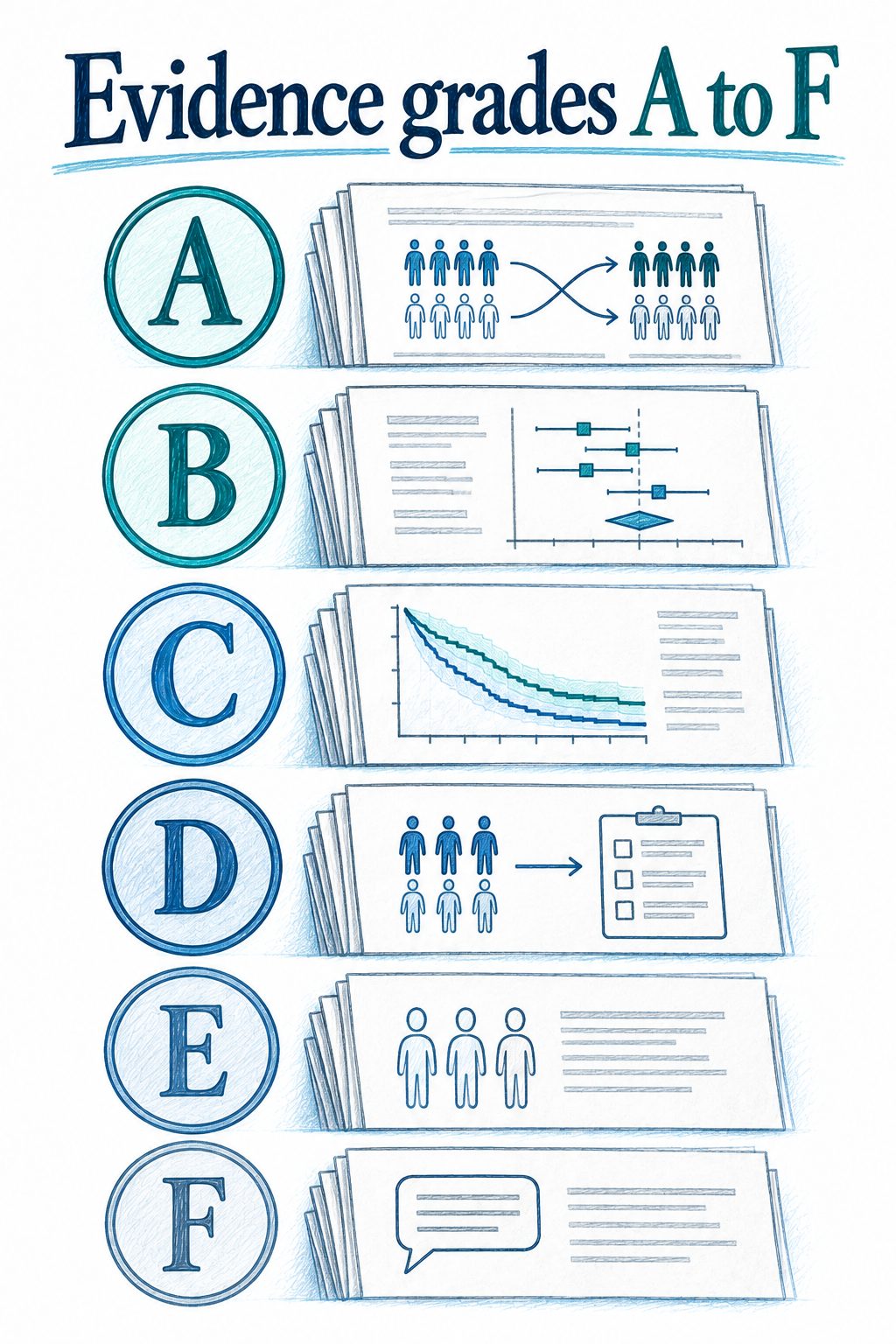
Applying our evidence approach to each claim separately, because the two compounds have different evidence bases and the comparison is only as strong as its weakest link:
BPC-157 for injury healing in humans: insufficient evidence. The animal tendon and ligament literature is real but comes largely from one research group, the human record is small uncontrolled observations plus registered trials with no published results, and the single controlled human program (the ulcerative-colitis enema study) exists only as a twenty-year-old conference abstract in a different indication. Animal results cannot substitute for human evidence.
TB-500 for injury healing in humans: insufficient evidence. The fragment has no published controlled human trials for any indication, and the full-protein thymosin beta-4 human data does not transfer across the fragment boundary.
The full-protein thymosin beta-4 human data: real but non-transferable, and mixed on its own terms. The dry-eye phase 2 trial's co-primary endpoints did not reach significance, the neurotrophic keratopathy "phase III" enrolled only 18 subjects, and the injectable cardiac program produced safety data only. Whatever these programs established, they established it about a different substance than TB-500.
The combined "stack" for recovery: insufficient evidence, with no published study testing the combination for injury outcomes in humans. Combining two insufficient evidence bases does not produce a sufficient one.
WADA status: high certainty that both are prohibited, based on the published Prohibited List: BPC-157 under S0, and "Thymosin-β4 and its derivatives e.g. TB-500" under S2. This is a regulatory fact, not a research finding.
See how we rank peptides by evidence strength for where BPC-157 sits on the overall ladder, and the tissue repair research topic for the full animal-study record behind these grades.
The bottom line: different molecules, same evidence gap
BPC-157 and TB-500 are not two versions of one thing. One is a 15-amino-acid pentadecapeptide with a concentrated animal literature on tendon and ligament healing. The other is a fragment of a 43-amino-acid protein whose human research belongs to the full protein, not the fragment.
What they share is the gap: no published controlled human trial of either one for injury healing, and a market that sells the combination on mechanism stories rather than results. The honest comparison is not which one works better. It is that the research has not yet answered whether either works in people at all.
Sources
Staresinic M, et al. Gastric pentadecapeptide BPC 157 accelerates healing of transected rat Achilles tendon and in vitro stimulates tendocytes growth. J Orthop Res. 2003;21(6):976-983. PMID: 14554208.
Krivic A, et al. BPC 157 and Achilles tendon-to-bone healing after detachment in the rat. J Orthop Res. 2006;24(5):982-989. DOI: 10.1002/jor.20096.
Chang CH, et al. The promoting effect of pentadecapeptide BPC 157 on tendon healing involves tendon outgrowth, cell survival, and cell migration. J Appl Physiol. 2011;110(3):774-780. PMID: 21030672.
Cerovecki T, et al. Pentadecapeptide BPC 157 (PL 14736) improves ligament healing in the rat. J Orthop Res. 2010;28(9):1155-1161. DOI: 10.1002/jor.21107.
Huang T, et al. Effect of the pentadecapeptide BPC 157 on alkali-burn-induced skin wound healing in a rat model. PMID: 25995620.
Hsieh MJ, et al. Therapeutic potential of pro-angiogenic BPC157 is associated with VEGFR2 activation and up-regulation. J Mol Med. 2017;95(3):323-333. PMID: 27847966.
Pevec D, et al. BPC 157 and muscle healing impaired by systemic corticosteroid treatment. Med Sci Monit. 2010;16(3):BR81-BR88. PMID: 20190676.
Sebecic B, et al. The healing of a segmental defect in the rabbit long bone by BPC 157. Bone. 1999;24(3):195-202. PMID: 10071911.
Bock-Marquette I, et al. Thymosin beta 4 activates integrin-linked kinase and promotes cardiac cell migration, survival and cardiac repair. Nature. 2004;432(7008):466-472. PMID: 15565145.
Sosne G, Ousler GW. Thymosin beta 4 ophthalmic solution for dry eye: a randomized, placebo-controlled phase II clinical trial conducted using the controlled adverse environment (CAE) model. Clin Ophthalmol. 2015;9:877-884. PMID: 26056426.
Lee E, Padgett B. Intra-Articular Injection of BPC-157 for Multiple Types of Knee Pain. Altern Ther Health Med. 2021;27(4):8-13. PMID: 34324435.
Vasireddi A, et al. The Emerging Use of BPC-157 in Orthopaedic Sports Medicine: A Systematic Review. 2025. PMID: 40756949.
Esposito S, et al. Characterization of a TB-500 product by LC-MS: identification of the N-terminal acetylated 17-23 fragment of thymosin beta 4. Drug Test Anal. 2012. PMID: 22962027.
World Anti-Doping Agency. 2026 Prohibited List (categories S0 and S2.3). wada-ama.org.
ECRI / Institute for Safe Medication Practices. Safety risks tied to unregulated peptides (gray-market purity and contaminant findings), 2026.
Keep reading
- BPC-157 research profile Every conclusion with its supporting studies, graded by evidence strength.
- BPC-157 human trials: the complete list Published pilots, historical abstracts, and registered trials, with what each one did and did not test.
- Tissue repair research topic What the research says about peptides studied for tissue repair, and where the human evidence runs out.
- Peptides ranked by evidence strength Our compound profiles ordered by how strong the human evidence is.